Compliance Is About Communities, Not Just Paperwork and Checkboxes

17 February 2026

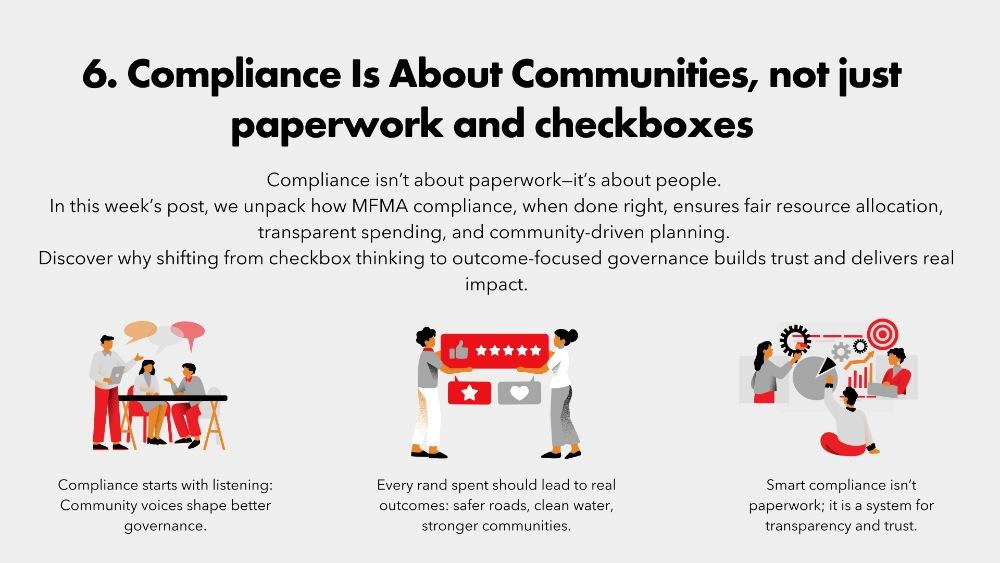
When people think about MFMA compliance, it is easy to view it as a set of bureaucratic tasks or reporting obligations. But in reality, it is much more than that. At its core, MFMA compliance serves communities—ensuring fair access to resources, responsible use of public funds, and transparent delivery of essential services. Rather than just fulfilling formal requirements, the purpose of this compliance is to ensure that every rand spent can be traced to tangible outcomes such as better roads, healthcare facilities, clean water, and community services. Let’s look at some myths vs facts: shifting the View on Compliance

Myth 1: Compliance is just about submitting reports.
Fact: Compliance is about ensuring that communities benefit from responsible planning and accountable governance. When properly embedded into the IDP and budgeting processes, compliance becomes a tool for stewardship, tracing every rand spent to specific results.

Myth 2: Compliance ends once the audit is completed.
Fact: Compliance is continuous. Capturing internal assessments and recording corrective actions in the appropriate systems enables municipalities to document findings and track progress over time. These activities may seem moderate in complexity, but they are essential for maintaining oversight and fostering a culture of improvement.

Myth 3: Public participation is just a legal requirement.
Fact: Public participation is an essential part of responsive governance. Local municipalities that actively gather and organise community feedback are better positioned to deliver services that reflect real needs. Structured feedback methods—such as surveys, workshops, and digital platforms—ensure stakeholder voices are captured, categorised, and visible throughout planning and reporting cycles.

Myth 4: Planning can succeed without direct community input.
Fact: Planning without community involvement risks failure. Linking stakeholder feedback directly to projects and strategies ensures that budget decisions reflect real priorities and builds public trust.

At the heart of compliance in local government is the delivery of reliable services, equitable resource distribution, and transparent spending of public funds. By aligning compliance processes with community priorities, municipalities can:

  • Deliver services more effectively,
  • Make better use of limited resources,
  • Build stronger relationships with the public.

This means focusing on real outcomes — such as safer roads, improved clinics, or new water infrastructure—and showing how decisions and spending led to those results.

This community-driven approach encourages municipalities to view compliance not as a burden but as a trust-building tool. Public participation in the IDP process guarantees that community voices influence planning and decision-making. However, fragmented systems or poor documentation often lead to lost or overlooked inputs. Investing in smarter ways to capture, categorise, and link stakeholder feedback—especially during the IDP process—can significantly improve both accountability and service delivery.

When municipalities prioritise people-centred compliance, governance becomes a vehicle for meaningful change. Recognising the complexities of local contexts, this approach fosters transparency and inclusiveness, transforming governance into a catalyst for positive development. By doing so, municipalities can build stronger trust with their communities and promote sustainable, equitable growth. In short, compliance should not be seen as a burden but as an enabler of good governance and better communities.
Capital investment prioritisation

Novus3’s innovative and celebrated approach to prioritsation, stems from significant multi-disciplinary experience that was gained in-situ at local government level, firmly rooted in an understanding of the built environment. Through the use of the CP3 system, our clients have the ability to appraise large and complex capital demand requirements within minutes, resulting in defendable, evidence based budgets. The results are often challenged and stress tested by politicians during political debates – the process therefore repeatedly have been proven to be beyond reproach and consistently reliable.

IDP Process Plan and change management

Novus3 provides advisory services to our clients, supporting them in setting up the correct structures and mechanisms internally which becomes the basis for sustainable and collaborative planning and implementation. The IDP process plan has a number of inter-related complexities that plays out on a cyclic basis year-on-year. Pre-empting and reacting to upcoming requirements in the IDP process pro-actively, renders the process into a constructive and demonstratable outcomes-based process.

Public sector budget and fiscal impact simulation

The financial management of public sector funding at local government level, even on a small scale, often rivals the complexity encountered at huge, listed, multi-national companies in the private sector.. Local governments have to operate and make smart financial decisions within a complex and exceedingly stressful environment. Compliance with legislation, policy frameworks and accepted accounting practices have to be maintained. Simulating these complexities allows our financial executives to ask “What if?” questions and reliably peer into the future with a long-term understanding of the implications of decisions that are taken in the present.

Spatial Development Frameworks

Novus3’s specialised knowledge and access to bespoke and purpose-made spatial and other analytic tools, provided the company with the opportunity to develop unparalleled experience in the development of Capital Expenditure Frameworks (CEFs) by bringing a practical angle to the formulation of implementation plans. A realistic roadmap is provided on how to realise the objectives developed in the Spatial Development Frameworks of the municipalities where we were involved. In return for the development and submission of these CEFs, these municipalities were awarded with significant additional funding from central government.

Built Environment Performance Plans

As part of the National Treasury City Support Program, Novus3 was regarded as specialist advisors on the built environment value chain – a process embedded in Built Environment Performance Plans (BEPPs). BEPPs were intended to form the bedrock of municipal capital planning and management for larger cities (metros). Novus3’s specialist knowledge played a big role from an advisory and capacity building perspective during the development of a number of BEPPs that were developed for a number of metros.

Infrastructure Capital Investment Plans

Infrastructure investment has to find a balance between addressing historical backlogs and inequalities, maintaining satisfactory prevailing functionality and level of service and strategically investing in unlocking future opportunities and growth whilst acknowledging a plethora regulatory constraints, policies and rules. In the process, certain strategic outcomes are sought which may manifest spatially strategically or environmentally. Our infrastructure capital investment plans provide the strategic guideline and provide the recommendations to find this balance.

Capital Expenditure Frameworks

Novus3 has developed multiple capital expenditure frameworks (CEFs) for multiple municipal clients and are regarded as the sector leaders in this area. These CEFs are financial roadmaps providing clear direction on financial constraints, the most important capital and investment priorities, an understanding of the unique local fundamentals and a sustainable response to these multiplicity of challenges.

Project preparation processes

The efficient planning and execution of projects from the moment of idea conception until the last brick has been laid has been the subject of study from as early as the reign of the Roman Empire. The governance process within the public sector has to play an important role in the journey of project preparation. The under-expenditure of allocated funding regrettably is often the only element in the built-environment that consistently re-occurs. All too often, funding is allocated to projects that simply are not ready to proceed to the next step. Novus3’s CP3 system is used to aid clients in the progressive steps involved in the project preparation journey.