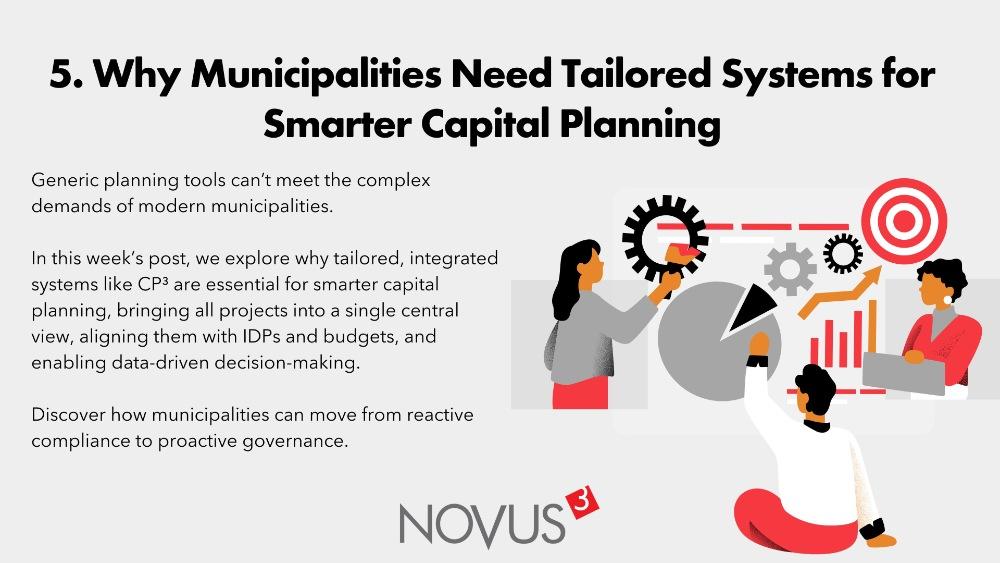
Every day, local municipalities face increasing pressure to make informed decisions about where and how to invest in infrastructure and services. Given limited resources, growing service demands, and compliance requirements, especially under the Municipal Finance Management Act (MFMA), it seems that traditional or generic planning systems often fall short. To overcome these challenges, many municipalities are now adopting a customised planning system that centrally consolidates project data, providing a unified view essential for planning, budgeting, and monitoring.
One effective approach is to use an integrated planning platform that brings all project data into a single, centralised system. This allows for better coordination across departments, more precise budgeting and reporting, and easier monitoring of project progress. When municipal officials have access to reliable, real-time information, planning becomes more strategic and less focused on just meeting compliance requirements. CP3 is one such platform, purpose-built to help municipalities align capital planning with legislative frameworks such as the MFMA and mSCOA. The system provides centralised visibility of all projects, linking them to the Integrated Development Plan (IDP) objectives and financial data, whilst offering spatial views to visualise impact and overlap.
A key feature of these systems is the use of standardised templates, such as the Long-Term Development Strategy (LTDS), embedded within the system. A consistent LTDS template with predefined sections for strategic objectives, risk assessments, and stakeholder inputs helps ensure alignment with other key municipal documents, such as the IDP, Spatial Development Framework (SDF), and Municipal Growth and Development Strategy (MGDS). By automatically pulling relevant financial data from integrated systems, these tools can significantly improve consistency, accuracy and efficiency in both project and capital planning.
Integration extends beyond planning. Once approved, documents can be stored with proper records management tools, including audit trails, role-based access and metadata tagging, thus supporting transparency and accountability at every stage
When choosing municipal planning systems, the goal should be to create a comprehensive platform that captures all capital projects in one place. Spatially mapping project impacts, ranking them based on transparent criteria, and ensuring real-time links to IDP and financial planning cycles enable more intelligent prioritisation under budget constraints. With features like those offered by CP3, municipalities can operate from a single source of truth, ultimately streamlining workflows and fostering public trust.
Still, any system must reflect the realities of local government: limited capacity, constrained budgets and growing scrutiny. Municipalities need to ask: Do our current tools help us make better decisions, or are they just for compliance? By opening up space for discussions around tailored, integrated solutions, municipalities can begin shifting from reactive processes to proactive, citizen-focused governance. These tools not only improve compliance but also help deliver real, measurable impact in communities. To find out how CP3 is helping municipalities streamline planning and improve service delivery, visit www.novus3.co.za or contact us for a demo.